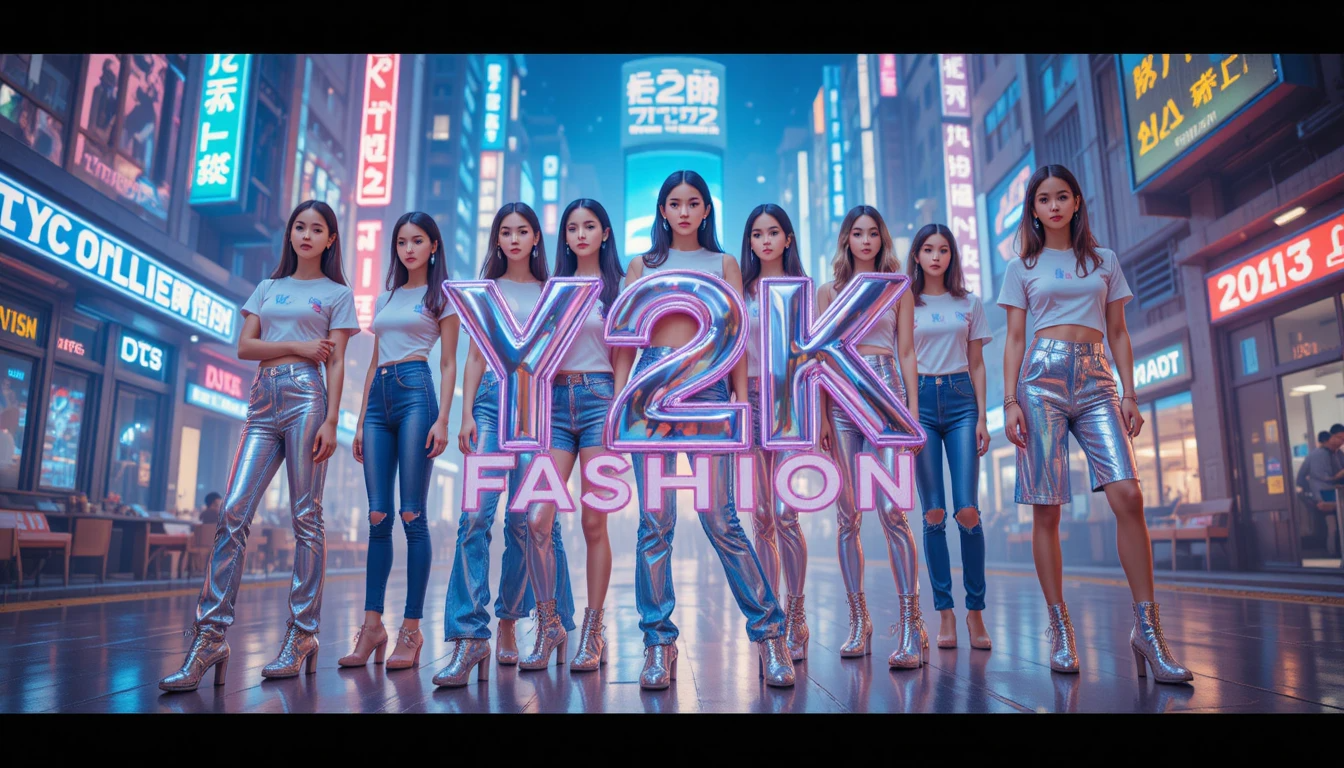
Y2K fashion is the style of roughly 1997 to 2004: low-rise jeans, baby tees, cargo trousers, metallic and holographic fabrics, chunky platform trainers, tinted sunglasses and butterfly clips, all shaped by millennium-era techno-optimism and the pop culture around it. It returned as a mainstream trend around 2020, and by autumn 2026 it is less a revival than a permanent part of the wardrobe: low-rise denim now takes a measurable share of mainstream denim sales, while the trend cycle itself has moved on towards 2005 and 2006.
This guide is built to be used. It covers the real timeline and its four distinct phases, the sales numbers from 2025 and 2026 that show where the trend has landed, the British version of the look, garment-by-garment detail with actual rise measurements from jeans on sale now, outfit formulas for women and men, fabric care for vintage pieces, the criticism worth taking seriously, what the cycle is moving towards next, and a realistic budget for building the look from Vinted, Depop and charity shops.
| Basics | Details |
| Core era | Approximately 1997–2004, peaking 1999–2002 |
| Driving influence | Millennium techno-optimism, music television, early digital culture |
| Defining garments | Low-rise bootcut and flared denim, baby tees, cargo trousers, halternecks, mini skirts over trousers |
| Footwear | Chunky platform trainers, square-toe boots, jelly sandals, Kickers |
| Fabrics | Polyester blends, PVC, mesh, velour, denim, metallic and iridescent coatings |
| Colours | Baby pink and blue, lime, silver, chrome, iridescent pastels |
| Accessories | Butterfly clips, tinted shield sunglasses, baguette bags, chunky belts, body glitter |
| British markers | Tammy Girl, Topshop Oxford Circus, Jane Norman carrier bags, Kappa poppers, Burberry check |
| Revival timeline | Began around 2020, mainstream by 2022, commercially embedded by 2026 |
| Rise on current low-rise jeans | 18.5–20cm (7.25–8 inches) on the ultra-low styles actually selling in 2026 |
| Second-hand cost | £4–£25 per garment on Vinted, Depop and in charity shops |
| High-street cost | £20–£90 for new reproductions |
| Archive designer | £150–£900+ for original Cavalli, Dior by Galliano, Blumarine and similar |
| Closest relatives | McBling (2003–2008), cybercore, indie sleaze (2006–2012) |
| What is arriving next | Mid-2000s boho, gaucho trousers, bandage dresses, lace camisoles |
Where Y2K Actually Came From
The aesthetic was a direct response to the millennium. For a few years either side of 2000, mainstream culture was genuinely convinced the future had arrived, and clothing behaved accordingly: reflective surfaces, technical-looking hardware, colours that suggested plastic and screens rather than nature.
Three things fed it. The first was cinema — The Matrix in 1999 put long leather coats, tiny rectangular sunglasses and black-on-black minimalism into every high street within eighteen months. The second was music television, where MTV and, in Britain, CD:UK and Popworld, turned three-minute videos into weekly style briefings. The third was consumer technology as fashion object: the translucent iMac in 1998, the iPod and its instantly recognisable white earphones in 2001, and the Motorola RAZR in 2004 were all styled to be seen.
Crucially, the era was not one look. It moved through phases, and most people who say “Y2K” mean only one of them.
| Phase | Years | Look | Touchstones |
| Techno-futurism | 1997–2000 | Silver, chrome, PVC, mesh, tiny sunglasses, minimal silhouettes | The Matrix, translucent electronics, club culture |
| Peak pop Y2K | 2000–2002 | Low-rise bootcut denim, baby tees, halternecks, butterfly clips | Chart pop, teen magazines, high-street explosion |
| Sporty and casual | 2001–2003 | Tracksuit sets, poppers, trainers, branded caps, hoodies | Garage and hip-hop crossover, football casual influence |
| McBling | 2003–2008 | Velour tracksuits, rhinestones, tiny handbags, tanned excess, logos | Reality television, celebrity paparazzi culture |
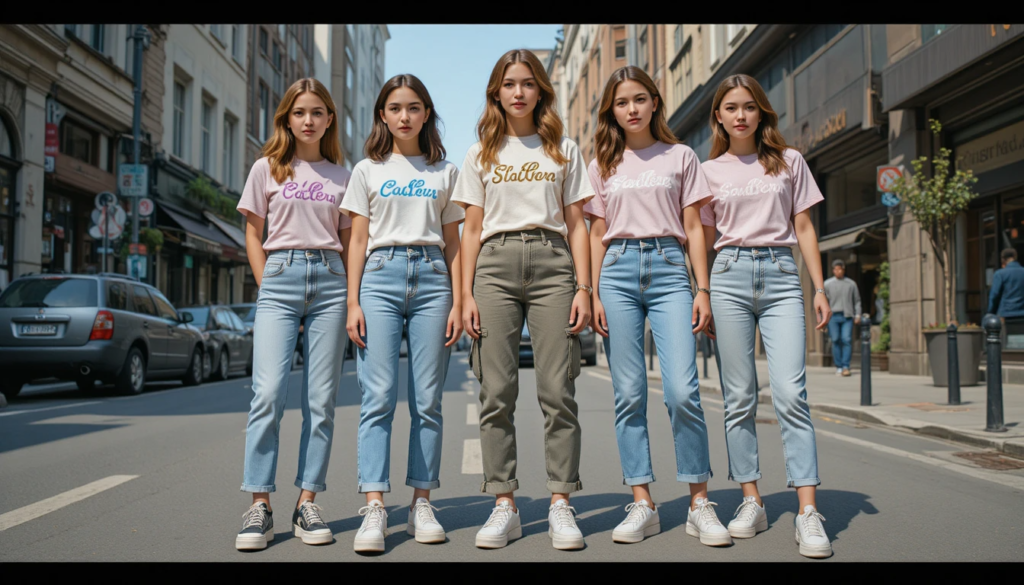
What Changed in 2025 and 2026: The Numbers
Most Y2K writing still treats the revival as a social media curiosity. That stopped being accurate somewhere in the second half of 2025, when the trend showed up in denim sell-through data rather than only in search interest. The shift is worth setting out precisely, because it changes what you can actually buy.
| Brand or measure | Figure | Period |
| Reformation low-rise denim sales | Up around 500% year on year | 2025 against 2024 |
| Lucky Brand low-rise sales | Up around 763%, rising from 8% to 43% of full-price denim | August 2025 against August 2024 |
| Citizens of Humanity and Agolde | Low-rise now roughly 35% of the bottoms business; four of the ten best-selling styles | 2026 |
| Designer runway share, low-rise | 17.8% of looks, up 11.8 percentage points year on year | Autumn/winter 2025–26 shows |
| Reformation low-rise buyer split | 38% Gen Z, 30% millennial | 2025 e-commerce |
Those figures are drawn from denim executives quoted in Fast Company’s reporting on the return of ultra-low-rise denim, and they carry two implications. First, the low rise is no longer a niche within a niche; a third of one major premium denim group’s trouser business now sits there. Second, the trend has a runway component as well as a resale one, which historically means it lasts longer than a purely social media aesthetic.
The forecasting view points the same way. WGSN’s denim team, which began tracking the low-rise signal as far back as 2019, has said openly that more ultra-rises are expected through 2026 rather than fewer. Denim also moves slowly compared with fast fashion, so a denim trend that is measurable in sell-through tends to sit for two to three years rather than a season.
The rise measurements that matter now
The original era’s low-rise sat at a front rise of roughly 15–18cm, or 6–7 inches, against 28–30cm for the high-waisted jeans that dominated the 2010s. What is useful in 2026 is that the revival has settled on specific, buyable numbers rather than a vague idea of “low”.
- Ultra-low, as currently produced: around 18.5cm (7.25 inches) on the most aggressive mainstream styles, such as Lucky Brand’s two-button Addison flare.
- Low, as currently produced: around 20cm (8 inches), the rise Agolde uses on its low-rise bootcut. This is the figure most people mean when they say low-rise in 2026.
- The commercial sweet spot: roughly 22–24cm, sitting about an inch below the navel. Reformation’s best-selling Cary slouchy wide leg is closer to this than to a true ultra-low.
- Period-accurate 2001: 15–18cm, which is lower than almost anything sold new today and is why genuine early-2000s pairs feel so different on.
When buying second-hand, ask for the front rise in centimetres and ignore the label entirely. A “low-rise” from 2002 and a “low-rise” from 2026 can differ by five centimetres, which is the difference between a garment you wear and one that stays in the wardrobe.
The British Version Was Different
Most Y2K content is written from an American perspective, and it misses what the era actually looked like on a British high street. The UK version had its own institutions.
- Tammy Girl inside BHS was where an entire generation of British teenagers bought their first Y2K clothes, and it defined the pastel-and-glitter end of the look.
- Topshop at Oxford Circus functioned as the country’s trend barometer, several years before its later decline.
- Jane Norman carrier bags — the pink drawstring ones — were carried as school bags long after the clothes inside had been forgotten, an authentically British status marker with no US equivalent.
- Kappa popper tracksuit bottoms and Adidas three-stripe sets arrived through garage and football culture rather than through pop, and that streetwear lineage still shapes how the look reads in British cities. Our piece on the Supreme London store and its place in UK streetwear traces where that thread went next.
- Burberry nova check became so widely counterfeited that the brand withdrew it from much of its range — a class-inflected episode in British fashion that has no clean American parallel.
- Kickers and Rockports did work that American platform brands did in the States.
What happened to those brands since
Two of them have had genuine second acts, and the outcomes are instructive about how nostalgia actually monetises.
Tammy Girl came back, briefly, and then vanished again. The label ran as an Etam spin-off from 1975, moved to BHS in 2005, and disappeared when BHS collapsed. In 2022 the Manchester retailer Daisy Street relaunched it as a 32-piece Y2K-inspired collection sold exclusively through ASOS, with crop tops at about £15 and a revived bubble bag at about £24. It was structured as a six-month exclusive, no follow-up collection arrived, and by 2026 the brand’s social accounts had been dormant for more than two years. The lesson: nostalgia sells a launch, not a business.
Topshop has been rebuilt more carefully. ASOS bought the brand out of Arcadia’s collapse in 2021, then sold a majority stake in October 2024 to a joint venture led by Heartland, the Danish investment vehicle behind Bestseller and Anders Holch Povlsen. A standalone Topshop.com returned in the second half of 2025, and the brand’s route back to physical retail has been through wholesale concessions inside other retailers rather than a reopened Oxford Circus flagship. If you grew up buying Y2K clothes there, the version returning is a wholesale label, not the department store.
If you are recreating the look in Britain, leaning on these references produces something far more convincing than copying a Los Angeles reference board.
The Garments, Specifically
Low-rise denim
The defining item and the most misunderstood. Cuts to look for: bootcut, flare, and the wide straight leg, with the slouchy wide leg now outselling the skinny-through-the-thigh bootcut that defined 2001. Washes: pale blue, whiskered mid-blue, and the heavily distressed sandblast finish, with grey washes and a very pale “dirty white” both gaining ground in 2026. Details that date a pair correctly are contrast stitching, small back-pocket embroidery, and a slightly stiff, non-stretch denim. Modern reproductions almost always contain more elastane than the originals, which is comfortable but changes how the waistband sits.
Baby tees and cropped tops
Short in the body, tight in the sleeve, usually with a slogan, a small graphic, or a rhinestone transfer. The authentic ones are cotton-lycra with a ribbed neckline. A modern shrunken tee in a heavy cotton reads wrong; the point was that the fabric was thin. The lace-trimmed camisole, a 2003 staple, is the version with the most momentum going into autumn 2026.
Cargo trousers
Loose through the leg, low on the waist, with genuine bellowed pockets rather than the flat decorative ones sewn onto most modern versions. Khaki, stone and black were standard; the zip-off convertible pair was a genuine early-2000s staple.
Halternecks and asymmetric tops
The single-shoulder top, the tie-back halterneck and the handkerchief hem were the going-out uniform. Satin-finish polyester, mesh overlays and lace trim all belong here.
Tracksuits and velour
The velour two-piece is the McBling era’s signature. Baby pink, powder blue and grey, worn with a bare midriff and trainers. This is the most divisive item of the revival, and it works best now when treated as separates rather than as a matching set.
The skirt-over-trousers combination
A denim or pleated mini worn over bootcut jeans or leggings. It was ubiquitous in 2001, ridiculed for twenty years, and has returned with a straighter face. The long, lean skirt silhouette that runs alongside it is a softer entry point, and our guide to styling a white maxi skirt covers how that shape works with the same low-slung waistline.
Outerwear
Cropped puffers, shrunken denim jackets, faux-fur-trimmed parkas and shiny nylon bombers carried the look through British winters. The bomber in particular has never really left, and choosing one in a heavier nylon or a proper satin rather than a papery lining is what separates a good version from a costume — our guide to the premium fabrics used in bomber jackets goes into which weights hold their shape. The fur-trimmed cropped hoodie, a 2006 Gucci silhouette, is the outerwear shape currently moving fastest.
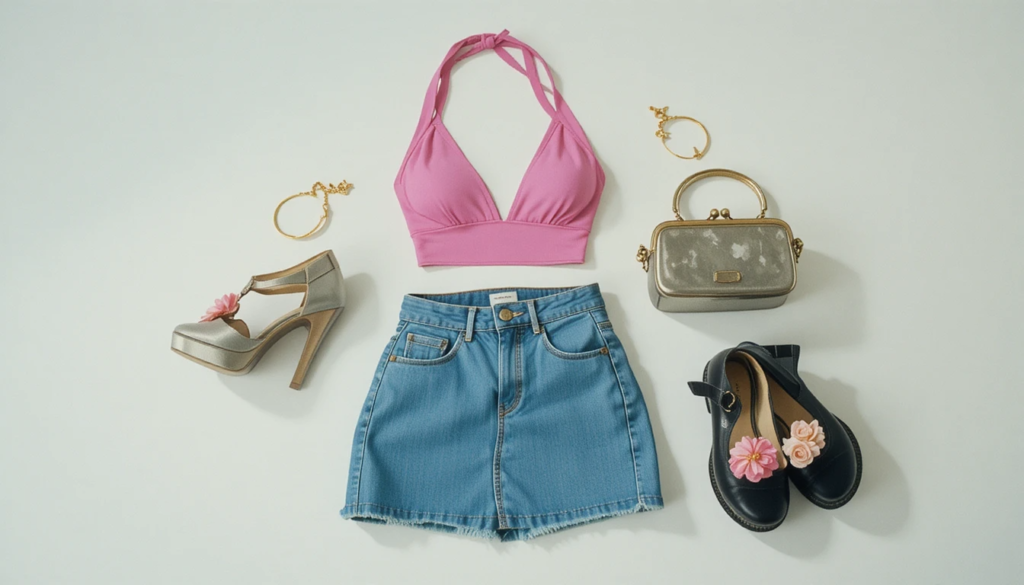
Footwear and Accessories
- Chunky platform trainers — the exaggerated sole is the single most recognisable silhouette of the period, and the one modern brands reproduce most faithfully.
- Square-toe knee boots in leather or PVC, usually with a block heel, worn over bootcut jeans.
- Jelly sandals and plastic mules in translucent pastels — cheap then, oddly collectible now.
- Kickers and Rockports for the British school-gate version of the look.
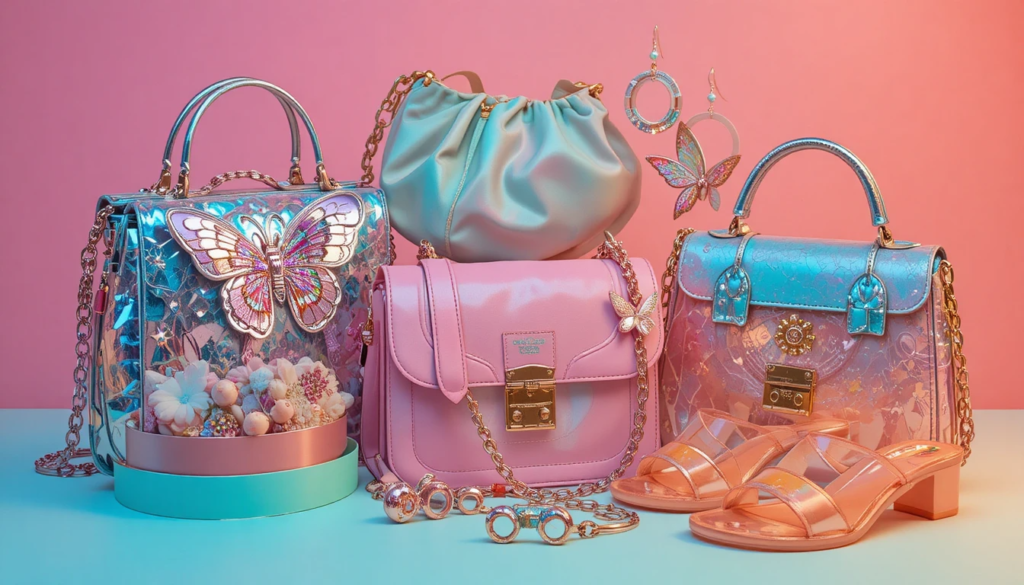
- Baguette and shoulder bags, worn deliberately too small and tucked under the arm.
- Butterfly clips, claw clips, and zigzag partings — the fastest way to signal the era with a £3 spend.
- Tinted and shield sunglasses in rose, amber and blue, with wire frames.
- Chunky belts worn low on the hip, often studded, often over a dress.
- Body glitter, frosted lip gloss and thin plucked brows completed it, though the brows are one thing almost nobody has revived.
Footwear is where the high street reproduces the era most cheaply and most convincingly, because a platform sole is easy to manufacture and hard to get wrong. If you are buying new rather than second-hand, shoes are the sensible place to do it, and our round-up of River Island shoes covers the sort of chunky sole and square toe that carry the reference at high-street prices.
Y2K Hair and Make-up, Updated
Hair and make-up do a lot of the work in signalling the era, and they are the cheapest part to experiment with because nothing is permanent.
- Claw clips and butterfly clips: a half-up twist held with a claw clip, or two face-framing strands pinned back with small butterfly clips, is the easiest modern version.
- The flipped-out bob and sleek straight hair: both were everywhere in 2000 to 2002. A flat iron and a light shine spray get you there; you do not need the crunchy gel finish of the originals.
- Zigzag partings: use the tail of a comb and keep it subtle rather than sharp.
- Glossy lips: a clear or sheer pink gloss is the most recognisable make-up reference. Swap the very frosted, chalky shades of the period for something with more moisture.
- Shimmer, not glitter: a touch of highlighter on the cheekbones or inner corners nods to body glitter without the clean-up.
- Brows: leave the thin, over-plucked brow in the past. A natural brow with a glossy lip reads as current and still references the era.
If you only change one thing, make it the hair accessory. A £3 clip can carry an otherwise plain outfit into Y2K territory. Nails are another low-commitment option: pastel, chrome or French-tip manicures with a small rhinestone or two were common at the time and are easy to recreate at home. Keep the rest of the look simple so the detail stands out, and treat these as playful extras rather than requirements.
Y2K Outfit Formulas That Work in 2026
These combinations keep one or two era pieces as the focus and let modern basics do the rest. Each one can be built mostly second-hand.
| Occasion | Era piece | Modern balance | Finishing touch |
|---|---|---|---|
| Everyday | Mid or low-rise bootcut jeans | Plain fitted knit or a simple vest | White trainers and a small shoulder bag |
| Office-friendly | Wide, low-slung tailored trousers | Fine-gauge jumper and a structured coat | Tinted reading-style glasses or a slim belt |
| Night out | Satin halterneck or lace-trimmed camisole | Straight dark jeans or a black midi skirt | Strappy heels and a baguette bag |
| Winter weekend | Cropped puffer or faux-fur-trimmed parka | Relaxed jeans and a chunky roll-neck | Square-toe boots |
| Casual sporty | Track jacket or velour hoodie | Straight-leg jeans or tailored joggers | Retro trainers and a cap |
| Festival | Cargo trousers or a mini over leggings | Fitted vest and a lightweight shirt | Tinted shield sunglasses and a clip-on bum bag |
The pattern is consistent: one statement item from the era, neutral or contemporary pieces around it, and an accessory that confirms the reference. That balance is what stops the look tipping into fancy dress.
Y2K Fashion for Men
Menswear from the period is often left out of Y2K guides, but it has a clear vocabulary and much of it has returned quietly.
- Baggy and carpenter jeans: wide, long and low-slung, in mid-blue or a faded wash. Modern versions are usually a little shorter in the leg so they stack less.
- Cargo trousers and combats: the same bellowed-pocket shape as the women’s versions, in khaki, stone, black or camouflage.
- Tracksuits and poppers: the garage and football-terrace influence was strong in Britain. Wear a track jacket over a plain tee with jeans rather than the full matching set.
- Oversized sports jerseys and graphic tees: worn loose and long, often layered over a long-sleeved top.
- Chunky trainers and skate shoes: padded tongues and thick soles are the giveaway.
- Wraparound and shield sunglasses: sporty, curved lenses in tinted or mirrored finishes.
- Chain wallets, beanies and bucket hats: small, inexpensive accessories that place the outfit in the early 2000s instantly.
The same rule applies as for womenswear: one or two signals, not the full costume. Baggy jeans, a plain heavyweight tee and chunky trainers looks current; add a bucket hat, chain wallet and wraparound sunglasses all at once and it starts to look like a theme night.
How to Spot Genuine Early-2000s Pieces
Listings tagged “vintage Y2K” range from true originals to last year’s fast fashion. A few checks help you tell the difference before you pay:
- Read the label. Old high-street labels such as Tammy Girl, Jane Norman, Miss Selfridge and early Topshop designs are good signs, as are label styles and logos that the brand has since changed. Ask the seller for a clear photo of the neck or waistband label and the care label.
- Check the fabric composition. Original low-rise denim was often all cotton or very low stretch. A pair with a high elastane percentage is more likely to be a modern reproduction.
- Look at the construction details. Contrast stitching, small embroidered back pockets, flared hems and heavy sandblasting were typical of the period. Many modern versions simplify these.
- Compare the sizing. Early-2000s sizes generally ran smaller than today’s. If a “size 12” measures like a modern 8 or 10, it is more likely to be genuinely old.
- Ask about wear. Genuine vintage usually shows some age, such as slight fading or softened fabric. A perfect piece claimed as twenty years old may be deadstock, which is valuable, or a reproduction, which should be priced like one.
None of these checks is conclusive alone, but together they give you a good idea of what you are buying and whether the price is fair.
Wearing Y2K at Any Age and Size
The look is often marketed to teenagers and people in their early twenties, but the individual garments work far more widely if you adjust proportion and fabric.
- Choose your rise. If ultra-low feels uncomfortable, a mid rise with a bootcut or flared leg gives the same silhouette with more coverage and support.
- Swap the baby tee for a fitted knit. A fine rib jumper or a slightly longer fitted tee gives the cropped proportion without exposing the midriff.
- Use texture instead of skin. Satin, lace trim and a metallic accessory carry the reference without needing a very cropped top.
- Pick one silhouette to exaggerate. A wide hem on the jeans or a chunky trainer sole is enough; you do not need both.
- Lean on accessories. Tinted sunglasses, a small shoulder bag or a claw clip reference the era at any age.
Millennials who wore the originals often prefer this softer route, and it is also the approach that sits most comfortably alongside a wardrobe that is mostly classic pieces.
Y2K, McBling, Cybercore and Indie Sleaze: Telling Them Apart
| Aesthetic | Years | Palette | Signature | Status in 2026 |
| Cybercore / techno-futurism | 1997–2001 | Silver, chrome, black, acid green | PVC, mesh, tiny rectangular sunglasses, technical hardware | Niche, mostly clubwear |
| Y2K proper | 1999–2003 | Baby pink, powder blue, lime, iridescent pastel | Low-rise denim, baby tees, butterfly clips, platform trainers | Absorbed into the mainstream |
| McBling | 2003–2008 | Hot pink, gold, animal print | Velour tracksuits, rhinestones, visible logos, tiny bags | Rising, now the live reference |
| Indie sleaze | 2006–2012 | Black, red, flash-photograph white | Skinny jeans, band tees, American Apparel, disposable-camera grain | Mainstream through 2026 |
Getting this distinction right matters if you are buying: a velour tracksuit and a chrome mesh top are both sold under the Y2K tag online, and they belong to completely different years and moods.
What the Cycle Is Moving Towards Next
The twenty-year rule has now carried the reference point past 2004 and into 2005 and 2006, which means the aesthetic arriving is mid-2000s boho and the tail end of McBling rather than millennium chrome. The pieces with visible momentum going into autumn and winter 2026 are specific:
- Lace-trimmed camisoles, layered over long-sleeved tops, which have moved from resale into mainstream ranges at brands including Hollister and Skims.
- Gaucho trousers — the wide, cropped, mid-calf shape — returning alongside a broader softening of the 2000s silhouette towards cotton and relaxed cuts.
- Ponchos, suede, fringing and gladiator sandals, the whole Sienna Miller and early boho vocabulary, which is the clearest signal that the cycle has reached 2005.
- The bandage dress, revived commercially by House of CB and pulling renewed attention back to the Hervé Léger archive, riding the same return of going-out dressing that carried indie sleaze.
- The cropped, fur-trimmed hoodie, a 2006 Gucci silhouette from the Frida Giannini years, given a second life through Madonna’s Confessions anniversary cycle.
The practical use of knowing this: second-hand prices lag the trend by roughly a season. Mid-2000s boho and McBling pieces are still cheap on Vinted and in charity shops precisely because they are not yet what people search for. Y2K proper, by contrast, now carries a tagged premium.
Building a Y2K Wardrobe in 2026: What It Costs
| Source | Typical price | Best for | Watch out for |
| Charity shops | £3–£12 | Genuine early-2000s denim, belts, bags | Stock is random; visit often rather than once |
| Vinted | £4–£20 | Volume buying, tops, tracksuit pieces | Sizing is inconsistent; always ask for measurements |
| Depop | £10–£45 | Curated, styled pieces | Revival premium on anything tagged “Y2K” |
| eBay | £8–£60 | Specific brands and deadstock | Postage costs and returns friction |
| High street reproductions | £20–£90 | Fit, size range, new condition | Fabric is often thinner than the originals |
| Archive designer resale | £150–£900+ | Cavalli, Blumarine, Dior by Galliano, Miu Miu | Fakes are common; verify seller history |
A convincing four-piece starter set — one pair of bootcut low or mid-rise jeans, one baby tee, one going-out top, one pair of platform trainers — comes to roughly £45 to £80 buying second-hand, or £110 to £200 new. The second-hand route is also the more accurate one, because the fabric weights and cuts of original garments are noticeably different from modern reproductions.
Why second-hand is now the default, not the alternative
The economics have shifted decisively. Vinted has grown to around 17.4 million UK users and roughly 105 million registered users globally, and by gross sales it now ranks as one of the largest fashion retailers operating in Britain, behind only Primark and Next. Its 2024 revenue was €813.4m, up 36% year on year, with the business on track to pass €1bn. Depop, owned by Etsy, has about 45 million registered users, roughly 90% of them under 26. Charity shop sales grew 1.4% over the last reported year, ahead of the 1.1% growth in non-food retail overall, according to Retail Gazette’s analysis of the UK resale market.
What that means in practice is that the archive is enormous, searchable, and competitively priced, and that selling on is now a normal part of the cycle rather than an afterthought. If you are buying to experiment rather than to keep, the resale value of a well-chosen piece is real; our guide to reselling on Vinted covers pricing, listing and postage for anyone planning to move things on.
Second-hand buying checklist
- Always request the flat waist measurement and the front rise in centimetres. Early-2000s sizing ran considerably smaller than equivalent labels today, and a size 12 from 2002 is often a modern size 8 to 10.
- Check inside leg and hem width on bootcut and flare — the drama is in the hem, and a narrow one just looks like an old straight leg.
- Look at the fabric composition. Non-stretch or very low-stretch denim is what gives the era its distinctive stiffness.
- Inspect PVC and coated fabrics for cracking at stress points. Twenty-year-old plastic coatings do fail and cannot be repaired.
- Smell test velour and polyester. Both hold odour stubbornly, and some of it does not wash out.
- Search the adjacent terms, not the trend term. Listings tagged “Y2K” carry a premium; the same garment listed as “bootcut jeans 2002” or under its original brand name is routinely cheaper.
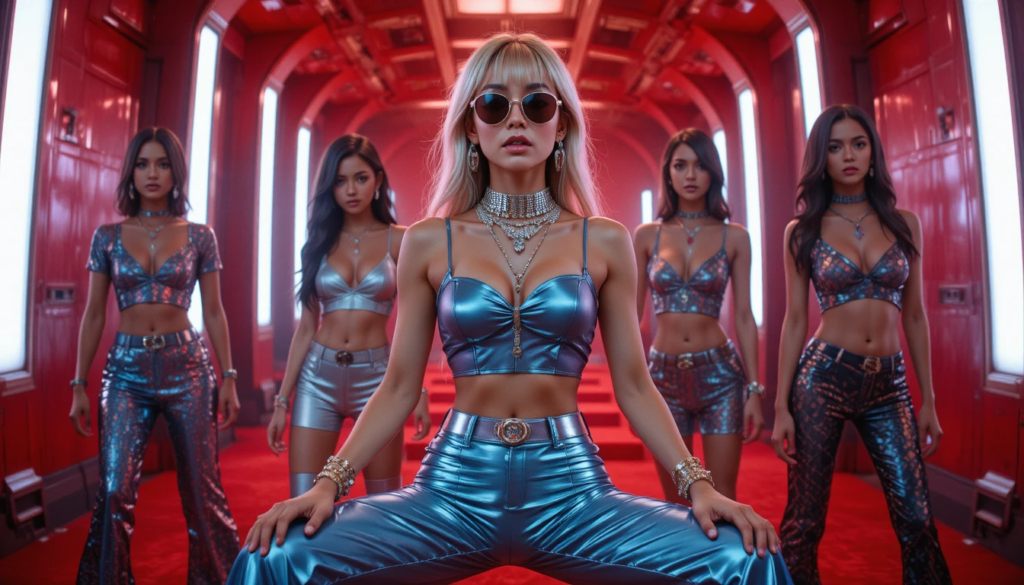
Caring for Vintage Y2K Fabrics
Second-hand pieces from the early 2000s are now more than twenty years old, and some of the era’s favourite materials age badly if they are handled like modern basics.
| Fabric | Main risk | How to care for it |
|---|---|---|
| Velour | Crushed pile, odour retention, bobbling | Wash inside out on a cool, gentle cycle; air dry flat; brush the pile lightly when dry |
| PVC and coated fabrics | Cracking and peeling at folds | Wipe clean rather than machine wash; hang rather than fold; keep away from radiators |
| Mesh and sheer synthetics | Snags and holes | Hand wash or use a mesh laundry bag; separate from zips and hooks |
| Non-stretch vintage denim | Fading and stiffness | Wash infrequently, inside out and cold; line dry to keep the shape |
| Rhinestones and transfers | Stones falling off, cracking prints | Wash inside out on cool; never tumble dry or iron directly over the decoration |
| Satin polyester | Water marks and heat damage | Cool wash, low iron with a cloth between iron and fabric |
When you buy, check seams, zips and poppers before anything else. Broken poppers on tracksuit bottoms and failed zips on cropped jackets are the most common faults, and they are usually cheap to fix at a local alterations shop. Cracked PVC, by contrast, cannot be repaired, so it is worth asking the seller for close-up photos of folds and seams first.
A Simple Y2K Capsule Checklist
If you want the look without buying a whole new wardrobe, start with a small set of pieces that work with what you already own:
- One pair of bootcut or wide-leg jeans with a low or mid rise.
- One or two baby tees or fitted vests in white, pastel or with a small graphic.
- One going-out top: a halterneck, satin cami or lace-trimmed camisole.
- One pair of cargo trousers or a mini skirt to layer.
- One outer layer: a cropped puffer, shrunken denim jacket or nylon bomber.
- One pair of chunky trainers or square-toe boots.
- Two or three accessories: claw or butterfly clips, tinted sunglasses and a small shoulder bag.
That is enough to make a dozen different outfits, especially when mixed with plain knits, tailored trousers and a good coat you already own, and most of it can be found on Vinted or in charity shops for well under £100 if you are patient.
How to Wear It Now Without Looking Like a Fancy-Dress Costume
- One era piece per outfit, maximum two. Bootcut jeans plus a plain modern knit is Y2K. Bootcut jeans plus baby tee plus butterfly clips plus platform trainers plus tinted sunglasses is a themed party.
- Update the proportion. A 22–24cm rise instead of an 18cm one, a slightly longer tee, a platform sole that is chunky rather than architectural.
- Keep the fabric quality above the original. Much of the actual 2001 high street was thin polyester. A well-made version of the same shape looks far better and lasts longer.
- Use accessories as the entry point. A claw clip, a tinted lens, a small shoulder bag — these cost under £15 and signal the reference without commitment.
- Mix rather than match. The velour hoodie with tailored trousers; the cargo trousers with a fitted knit and a good coat. A pair of corduroy trousers in a wide, low-slung cut carries the silhouette without any of the period signalling at all.
- Skip the parts that were actually bad. Over-plucked brows, heavy body glitter and dip-dyed frosted tips are period-accurate and worth leaving in the period.
Common Y2K Styling Mistakes
- Buying by the tag, not the measurement. “Low-rise” means very different things across decades and brands. Check the front rise in centimetres every time.
- Wearing every reference at once. The fastest way to look costumed is stacking clips, tinted glasses, a baby tee, platforms and a velour set together.
- Mixing phases without meaning to. Chrome cybercore and pink McBling come from different years and moods. Pick one direction per outfit.
- Ignoring hem length. Bootcut and flared jeans need to skim the floor in the shoes you will wear. Too short and the shape collapses.
- Choosing the thinnest fabric. Cheap reproductions often copy the flimsiest parts of the original era. A heavier jersey or proper satin looks better and lasts longer.
- Overpaying for the trend tag. The same jeans listed as “2002 bootcut” are often far cheaper than when listed as “Y2K”.
Shopping the High Street for Y2K Pieces
Buying new makes sense for items where fit, hygiene or condition matter most: trainers, underwear-adjacent pieces such as camisoles, and jeans if you need a size range that second-hand stock rarely offers. Look for reproductions with better fabric weights than the originals, try jeans on in the shoes you plan to wear, and stick to one or two hero pieces rather than buying a full trend wardrobe that may feel dated within a couple of seasons. Pair new purchases with second-hand finds and existing basics for the most convincing, least costly result.
The Criticism Worth Taking Seriously
The low-rise revival has drawn a specific objection rather than a general one, and it deserves a straight answer rather than a defensive one.
The original era’s silhouette was built around an extremely narrow body ideal, and the clothes were sized accordingly. Ultra-low-rise jeans in 2002 were made in a limited size range, and the surrounding culture was explicitly hostile about bodies that did not suit them. Industry forecasters now say plainly that the ultra-low rise is not universally flattering and that the broader consumer appeal sits with mid and high rises, which is an unusually frank admission from people whose job is to sell the trend. Millennials who lived through the first run are, by most accounts, the group most resistant to it.
Three things have genuinely changed. Size ranges on new low-rise denim are far wider than the originals. The rise itself has been moderated: the commercially successful styles sit around 20cm rather than 15cm. And the trend now runs in parallel with high-rise and baggy cuts rather than replacing them, so the choice is genuinely a choice. None of that erases the objection, but it does mean the 2026 version is not a straight reissue of the 2002 one.
Why It Came Back, and Why It Has Stayed
The standard explanation is the twenty-year nostalgia cycle, and that is part of it. But the Y2K revival has outlasted a normal cycle for more specific reasons. Short-form video rewards visually loud clothing, and Y2K is loud by construction. Second-hand platforms made an enormous archive of genuine early-2000s stock cheaply available at exactly the moment the trend surfaced. And there is a plausible cultural reading: an era that believed the future would be shiny and fun has obvious appeal to a generation that mostly does not.
What has changed in the 2026 version is meaningful. Size ranges are far broader than the original era’s. The low rise has been softened towards mid. And the underlying attitude has shifted from following a trend to raiding an archive — people mix 2001 denim with 2016 minimalism and 1970s tailoring without treating any of it as a costume. That flexibility, plus the fact that the denim industry has now built inventory around it, is why the look has embedded rather than passed.
The Bottom Line
Y2K fashion is a specific, datable set of garments and references from roughly 1997 to 2004, not a general word for “retro”. Knowing which phase you are drawing from — the chrome futurism of 1999, the pop pastels of 2001, the velour excess of 2005 — is what makes an outfit read as considered rather than costumed. In 2026 the trend has stopped being a revival and become inventory: real sales data, real runway share, real rise measurements you can check before you buy. Buy second-hand where you can, ask for the front rise in centimetres before committing, search the adjacent terms rather than the trend tag, and let one or two pieces carry the reference.
Frequently Asked Questions
What years count as Y2K fashion?
The core period runs from roughly 1997 to 2004, peaking between 1999 and 2002. It moved through phases: chrome-and-PVC techno-futurism, the pop-pastel low-rise phase and a sporty tracksuit phase. The velour-and-rhinestone look many people picture is technically McBling, which ran from about 2003 to 2008.
How low were original Y2K jeans, and how low are they now?
Early-2000s low-rise jeans had a front rise of roughly 15 to 18cm, against 28 to 30cm for 2010s high-waisted styles. Revived versions in 2026 are moderated: about 18.5cm for the most aggressive ultra-low styles, about 20cm for standard low-rise and 22 to 24cm for the best-selling commercial cuts. Always ask for the front rise when buying second-hand.
Is Y2K fashion still a trend in 2026?
It has become standard inventory rather than a passing trend, with low-rise denim now a significant share of several premium denim brands’ sales and a growing share of runway looks. What has moved on is the reference point: the cycle has reached 2005 and 2006, so mid-2000s boho and McBling are the aesthetics now rising.
How much does it cost to build a Y2K wardrobe in the UK?
A four-piece starter set of bootcut jeans, a baby tee, a going-out top and platform trainers costs roughly £45 to £80 second-hand, or about £110 to £200 new on the high street. Charity shop finds start at around £3. Searching for the garment rather than the Y2K tag usually cuts the price.
What did Y2K fashion look like for men?
Men’s Y2K centred on baggy and carpenter jeans, cargo trousers, tracksuits and poppers, oversized jerseys, chunky trainers and wraparound sunglasses. In Britain, garage and football-terrace style shaped much of it. Wearing one or two of these pieces with modern basics keeps the look current.
How do I wear Y2K without looking like I am in fancy dress?
Limit each outfit to one or two era pieces and keep the rest contemporary. Bootcut jeans with a plain modern knit reads as current, while the same jeans with a baby tee, butterfly clips, platform trainers and tinted sunglasses reads as a themed party. Choosing a slightly higher rise and better fabric than the originals also helps.